
The Happiness Pie Chart Has Been Retired
Why The 50/10/40 Happiness Rule No Longer Holds Up
For close to twenty years, one statistic has done more to shape how coaches, leaders and self-help books talk about happiness than almost any other: 50 per cent genetics, 10 per cent circumstances, 40 per cent within your control through daily choices. It came from a 2005 paper by psychologist Sonja Lyubomirsky and her colleagues, and it gave a generation of people permission to believe that wellbeing was mostly theirs to build.
A newly published chapter from Lyubomirsky, co-authored with Kristin Layous for the sixth edition of The Handbook of Social Psychology, actually retires that pie chart. The heritability estimate has been revised to a range of 32 to 40 per cent. Life circumstances, once pegged at a flat 10 per cent, turn out to matter more or less depending on the person and the situation. The clean thirds are gone, replaced with what the authors call an interactionist model: a picture with far more moving parts, but one that I would argue is far more useful for anyone trying to lead under pressure.
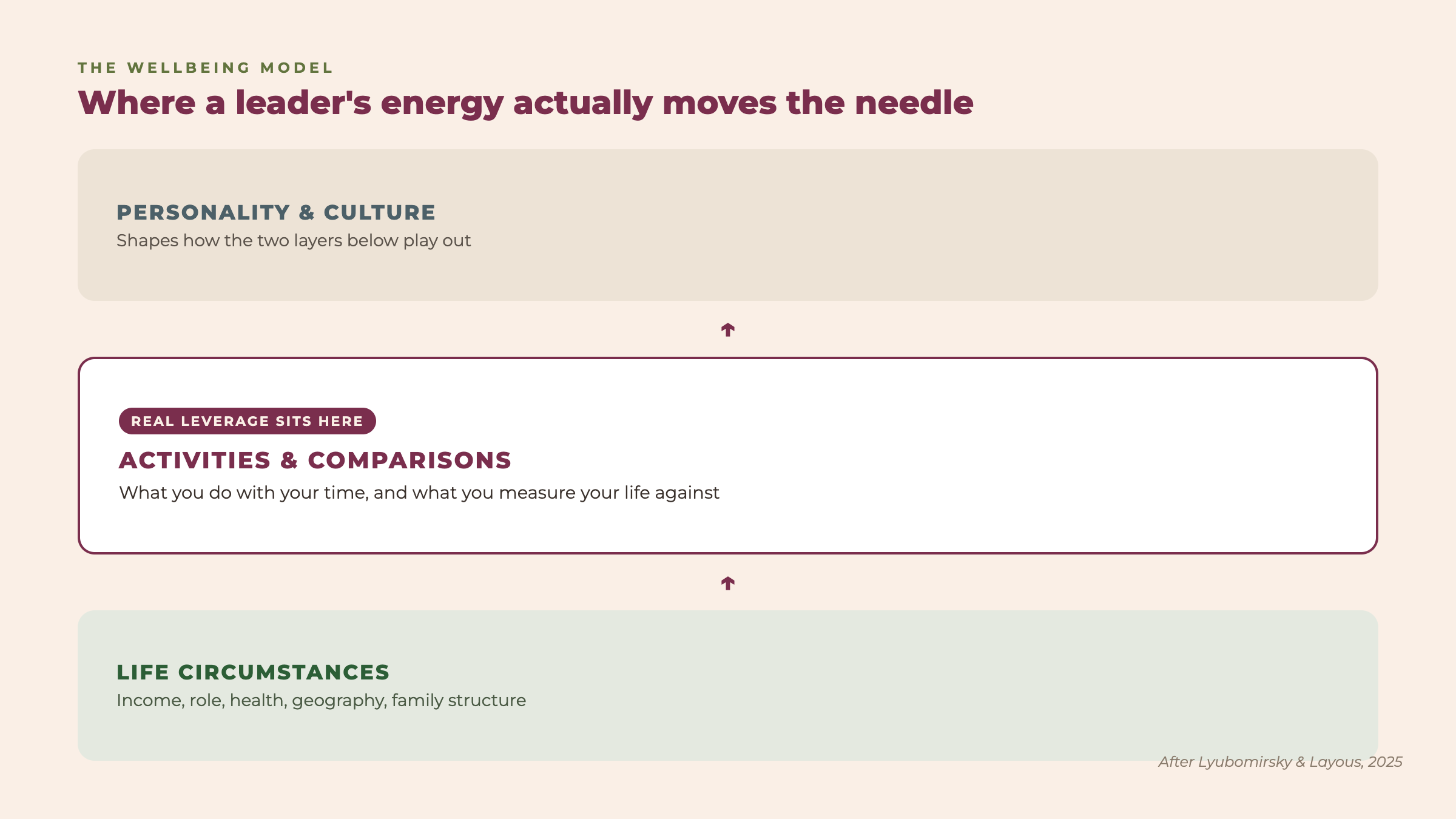
Here is the model in plain terms. At the bottom sit life circumstances: income, role, health, where you live, who your partner is. These are largely the facts of a life, and for a leader they're often the layer that consumes the most energy: the redundancy that wasn't your fault, the restructure that flattened your title, the board that won't move at your pace. In the middle sit two things the authors call activities and comparisons: what you actually do with your time, and what you measure your life against. At the top, personality and culture shape both. The arrow that matters most for coaching runs through the middle. Circumstances rarely affect wellbeing directly. They're filtered through how a person acts on them and what they compare them to.
This has a practical consequence the old pie chart never quite captured. Two leaders can hold the same job title, the same salary and the same flat quarter, and land in very different places emotionally, because one is comparing their year to where they hoped to be by now, and the other is comparing it to where they were twelve months ago. Neither comparison is wrong. But only one of them is a lever a coach, or a leader, can actually pull.
The chapter also revisits hedonic adaptation, the tendency to return to an emotional baseline after both good and bad events. The evidence is asymmetric in a good way - people adapt to negative events slowly and only partially. A divorce, a disability, a redundancy: the data shows a genuine and lasting hit to wellbeing that eases but rarely fully resolves. Positive events tell the opposite story. People adapt to them quickly and, it appears, completely. Getting married lifts life satisfaction for roughly two years before it settles back to baseline. Wage rises deliver a boost that fades. American incomes more than tripled between 1940 and 1990. Average wellbeing scores over that period went slightly backwards.
For a leader chasing the next title, hitting the next number, the next sign the effort has been worth it, this is uncomfortable and useful in equal measure. The promotion will feel exactly as good as it should. It won't, on its own, feel good for very long. What tends to hold up better is the layer this new model puts front and centre: the activities. Not circumstances changed, but what's done inside them, the comparisons chosen, and how consistently both are revisited rather than left to run on autopilot.
None of this argues that circumstances don't matter … they do, and actually this update makes room for a wider range in just how much. What it argues is that the piece worth a leader's attention, the piece a coaching conversation can actually move, was never the circumstance itself. It was always there, we can just see it more clearly now.
